Skip to content
A Lexus key isn’t just a remote—it’s part of a layered security system. The Lexus smart key system works with the vehicle anti-theft architecture to confirm the key is real, nearby, and allowed to start the car. That security-first design is why Lexus keys are different from other brands. It also explains why Lexus key programming and Lexus key fob replacement can feel more complex than people expect, especially with modern proximity key setups and advanced key encryption.
Lexus Keys vs Other Brands (What “Different” Really Means)
Lexus keys vs other brands isn’t about hype or a fancy badge. It’s about the security model and how deeply the key is tied into the car. Many cars use basic keyless entry, but the Lexus smart access system behaves more like a premium key system with tighter checks. That’s why Lexus keys are different from other brands, especially when it comes to keyless start security and how the vehicle decides what’s “trusted.”
Lexus treats keys as credentials, not tools
With a Lexus smart access setup, the fob isn’t just a remote that unlocks doors. It works like a digital credential. The car runs a Lexus key authentication process through proximity key authentication and other validation checkpoints before it lets anything important happen. Think of it as credential verification with multi-step authentication: first the car confirms the key is nearby, then it confirms the key is legitimate, then it decides what actions are allowed. That vehicle anti-theft architecture is a big reason Lexus feels “different” in real-world use.
Why that design increases replacement complexity
Here’s the trade-off: stronger security usually means fewer shortcuts. Because Lexus is built around a security-first design, replacing a key often involves controlled steps, compatibility checks, and careful programming rules that limit unauthorized key adds. That’s why Lexus keys are harder to replace, and why Lexus key replacement complexity is real, especially in lost keys complexity situations. From a locksmith perspective, the replacement difficulty isn’t random—it’s the system doing its job: protecting the vehicle, even if it makes the process more involved for the owner.
Lexus Smart Key Technology (System Architecture Overview)
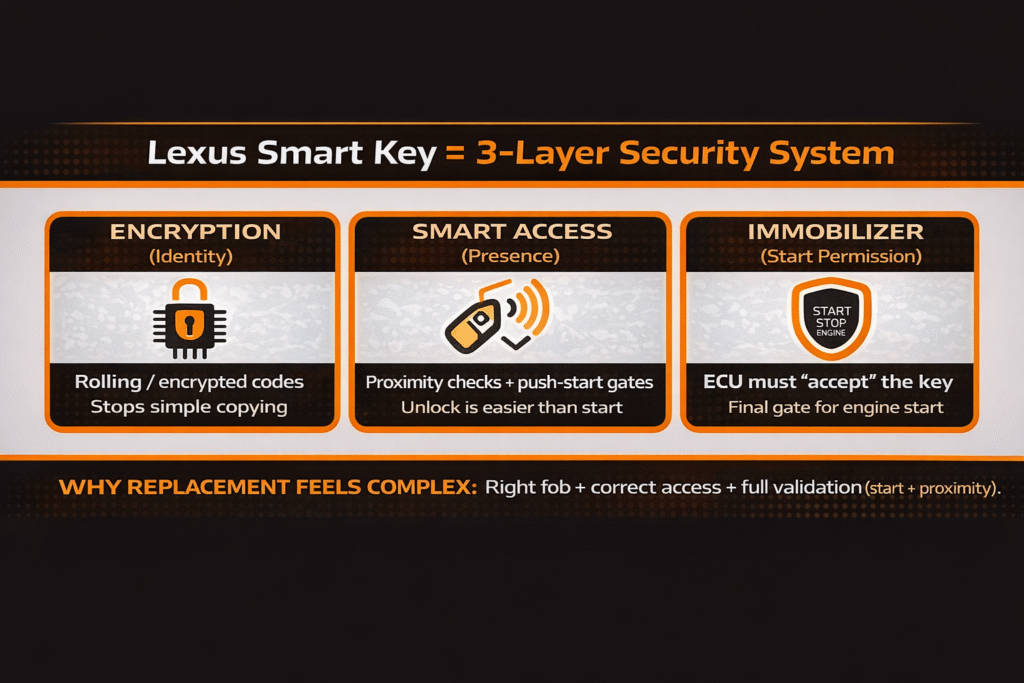
Lexus smart key technology is really an end-to-end system, not a single gadget in your pocket. The Lexus smart key talks to the car through antennas, then the signal gets checked by control modules before the vehicle gives start authorization. In simple terms, the fob sends a request, the smart access module listens, and the vehicle anti-theft architecture decides if that request is trusted. That’s the Lexus smart access system in action, built around a passive entry system and a keyless ignition that won’t allow shortcuts.
Proximity key system (passive entry / passive start)
The Lexus proximity key system works in zones around the car, often called key detection zones. When you approach, antennas look for the fob and run proximity key authentication to confirm it’s close enough and valid. That’s how proximity entry and passive start feel so smooth—you don’t press anything, but the car is still checking. The important part is that it doesn’t just “see” the key once. Conceptually, it keeps doing presence checks to make sure the key is still there, not just detected for a second and then gone.
Push-start security layer
Unlocking a door is one thing. Starting the engine is a bigger deal, so Lexus push-start key security adds more gates before start permission is granted. Push-button start authorization involves tighter verification because the risk is higher—once the car starts, theft becomes much easier. That’s why Lexus uses a security-first design inside its vehicle anti-theft architecture. From a locksmith’s point of view, this is where many “why won’t it start?” situations come from: the system is doing extra checks and refusing to authorize the keyless ignition unless everything matches exactly.
Lexus Key Encryption Technology (Why Copying Isn’t Simple)
Lexus’s key encryption technology is a big reason copying isn’t simple. Lexus uses advanced key encryption and rolling and encrypted codes, so the car doesn’t accept a “recorded” signal the way older systems might. That’s the advanced car key technology Lexus owners benefit from, but it also means universal fobs usually fail because they can’t match what the vehicle is expecting in real time.
Rolling and encrypted codes
With a rolling code system, the key and the car don’t keep using the same code again and again. They’re looking for a fresh, valid response each time, like an encrypted code key that keeps changing. If something comes in that looks “old,” out of sequence, or doesn’t fit the encrypted handshake, the system treats it as suspicious and denies it. That’s what anti-clone technology is supposed to do: make “copy-paste” attempts useless, even if someone thinks they captured a working signal once.
- Fresh-code expectation: The car expects a current, valid code—not yesterday’s.
- Mismatch = denial: If the response doesn’t line up, access gets refused.
Key authentication process (what the car verifies)
The Lexus key authentication process is more than “does a button press work.” The car runs authentication checks through proximity key authentication and the broader vehicle anti-theft architecture before it allows actions like unlock or start. It’s validating identity, then checking permissions, then applying safety gating—especially for start authorization checks. From a locksmith’s perspective, this explains why “it unlocks but won’t start” can happen: starting the car triggers stricter verification than opening a door, so the system may approve one action and block the other if something doesn’t match.
Lexus Immobilizer System (The “Final Gate” Experts Respect)
The Lexus immobilizer system is the final gate that experts respect because it controls one thing that matters most: start authorization. You can unlock doors all day, but if the security module doesn’t approve the key, the engine won’t run. That’s where immobilizer and ECU pairing come in. The vehicle anti-theft architecture is designed to block unauthorized starts, and in tougher cases, dealer-level diagnostics may be needed to handle the system safely and correctly.
Immobilizer and ECU Pairing
Think of immobilizer ECU pairing like a “marriage” between the car’s brain and the keys it trusts. The Lexus immobilizer system keeps a valid keys list, and the car checks the Lexus key authentication process against that list before allowing a start. When a new key is added, it isn’t just copied—it goes through key pairing and an ECU match process, often called immobilizer registration. The key is being introduced to the car’s security rules, and those rules don’t allow random changes. That’s why proper tools and correct steps matter so much with Lexus.
- Valid keys list: The car only starts for registered keys.
- Controlled changes: New keys must be properly matched, not “cloned.”
Why Immobilizer Security Raises Replacement Difficulty
This is where owners feel the downside of strong security. Because Lexus uses a security-first design, the immobilizer has tight access control that prevents quick DIY duplication. In real terms, that’s why Lexus keys are harder to replace—especially if you’ve lost all keys. The system often involves locked programming and restricted access pathways to stop thieves from adding keys easily. From a professional car locksmith’s point of view, this isn’t Lexus being difficult for no reason. It’s the immobilizer doing its job: protecting the vehicle, even when it makes replacement more involved than a basic key job.
Lexus Key Programming Process
The Lexus key programming process is a controlled, security-first pathway—not a “pair it and go” job. At a conceptual level, it follows a clear order: ownership verification, correct key selection, key fob programming, then validation tests. That’s why Lexus smart key programming feels more strict than many other brands. Whether it’s specialist locksmith programming or dealer-level diagnostics, the goal is always the same: register new key access without weakening the car’s anti-theft rules or creating future headaches.
- Verify + Match: Confirm ownership and the exact correct fob type
- Program + Prove: Add the key, then prove it works in real conditions
Add-a-Spare Programming (When You Still Have a Working Key)
If you still have one working key, this is the smoothest route and usually the most cost-effective. The car already recognizes a trusted credential, so the system doesn’t have to go into the most restrictive security mode. A specialist can follow Lexus key fob programming requirements, add spare key Lexus access, and keep everything aligned with how the vehicle expects keys to be registered. Even then, the details matter: the wrong fob type, wrong spec, or a low-quality replacement can stop the process cold. A legitimate “duplicate smart key” isn’t a copy in the casual sense—it’s a properly authorized key the car accepts as genuine.
Lost-All-Keys Programming (Highest Complexity Case)
Lost all Lexus keys is the toughest scenario because the car has no trusted starting point. When there’s no working key present, the system becomes far less forgiving and the workflow becomes more involved. This is where Lexus key replacement complexity shows up in real life, and it’s also why Lexus keys are harder to replace compared to basic systems. The process may depend on correct parts, correct access methods, and sometimes dealer-level diagnostics if the car’s security state requires it. From a locksmith point of view, this isn’t “making a new fob”—it’s rebuilding a trusted relationship between the vehicle and a new key, without creating a security gap that could be exploited later.
Validation and Testing (What Experts Confirm Before Handover)
Programming isn’t done just because the car accepts the key once. The real finish line is testing, because Lexus systems can behave inconsistently if something is slightly off. Pros verify the Lexus key authentication process across the smart access systems and confirm the Lexus proximity key system works the way an owner expects in daily use. That means checking lock/unlock from different distances, confirming proximity consistency around the doors and cabin, and making sure start authorization works repeatedly—not just one lucky attempt. A proper key detection test, start test, and range test help catch weak signals, wrong compatibility, or partial programming before the owner walks away thinking everything is perfect.
Why Lexus Keys Are Harder to Replace (Root-Cause Breakdown)
When people ask why Lexus keys are harder to replace, the honest answer is: Lexus built the system to protect the car first. The root causes are MECE—security model, parts specificity, programming requirements, and risk controls—and they stack up into real Lexus key replacement complexity. Add in replacement cost drivers like availability, programming time, and correct parts, and you quickly see why this isn’t a quick “cut and go” job.
- Real Drivers: Security rules, correct parts, strict programming, and controlled access
- Real Outcomes: Longer programming time, higher compatibility risk, and fewer shortcuts
Security-First Design (Less Tolerance for Shortcuts)
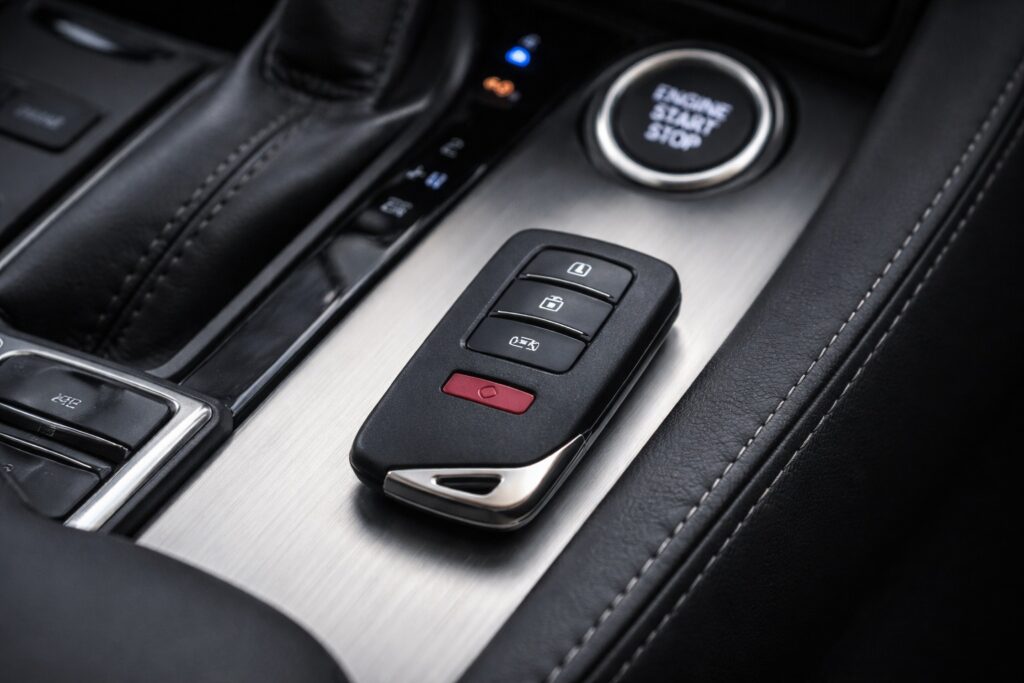
Lexus uses a security-first design with a high-security key system that leaves less room for workarounds. The vehicle anti-theft architecture is built to reduce unauthorized key additions, so the car doesn’t just accept “anything that looks close.” That’s why Lexus keys are different from other brands: the system treats key access like a controlled permission, not a convenience feature. From a locksmith’s perspective, this is a good thing for security, but it also means the job has to follow the right pathway. If a step is skipped or the wrong method is used, the system won’t “half accept” it—it will deny it.
Fob Programming Requirements and Compatibility Constraints
A big chunk of Lexus key replacement complexity comes down to one simple truth: the correct fob type matters. Lexus smart key technology has strict Lexus key fob programming requirements, and a compatible key fob must match the right spec—think correct frequency, correct chip type, and the right OEM spec for that model. This is why random online fobs can waste time and money. In tougher cases, you may need specialist locksmith programming or dealer-level diagnostics to handle the programming rules safely and get clean results. When everything matches, it goes smoothly. When it doesn’t, the car won’t cooperate—and that’s by design.
Dealer vs Locksmith Lexus Key Programming (Clear, Non-Salesy Comparison)
When it comes to dealer vs locksmith Lexus key programming, the best option is scenario-based, not hype-based. A dealer is usually strongest when you need OEM part sourcing or dealer-level diagnostics for a deeper vehicle issue. A locksmith is often the practical choice when you need specialist locksmith programming on-site, especially in real-world lockout or lost-key situations. The honest answer is that both have limits—so the goal is picking the path that solves your exact problem with the least risk, delay, and repeat visits.
Dealer vs Locksmith Lexus Key Programming (Best Option by Scenario)
| Scenario | Best Option | Why |
| Adding A Spare Key (You Have One Working Key) | Lexus Locksmith Programming | Lower complexity, fewer security escalations, specialist workflow. |
| Lost All Lexus Keys | Depends | Locksmith for on-site resolution; dealer if OEM-only parts or deeper access is required. |
| Module-Level / Security System Issues | Lexus Dealer Key Programming | Dealer-level diagnostics and OEM diagnostics fit module faults best. |
| Warranty Context | Lexus Dealer Key Programming | Warranty rules and dealership solution documentation may matter. |
| Stranded And Need On-Site Help | Expert Car Locksmith Services | Mobile help is often the most practical route. |
| OEM-Only Key/Fob Sourcing Needed | Lexus Dealer Key Programming | Dealers can usually source the correct OEM spec more directly. |
Owner Best Practices (Reduce Future Replacement Pain)
Lexus keys are built around a security-first design, which is great for theft protection—but it also explains why Lexus keys are harder to replace when something goes wrong. The smartest move is prevention. A simple spare key plan and basic key fob maintenance can save you from bigger key replacement challenges later, especially if you ever lose your only working key.
If your fob starts acting “off,” don’t wait. Early replacement is almost always easier than fixing a full failure or dealing with a lost-all-keys situation.
- Make A Spare Early: Add a backup while you still have a working key.
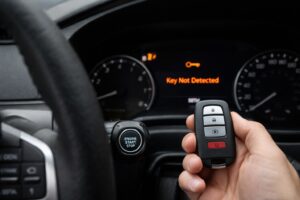
- Replace The Battery On Time: Weak batteries cause false “key not detected” problems.
- Store Keys Safely: Keep keys in one spot at home and avoid leaving them loose in bags.
- Protect The Fob From Damage: Drops, water, and heat can ruin the internal electronics.
- Watch For Warning Signs: Short range, intermittent unlock, or slow response means trouble is coming.
- Avoid Unknown Cheap Fobs: Wrong specs create delays, extra programming time, and wasted money.
FAQs
The best way is to follow a spare key plan and add a second key while you still have one working. Lexus systems are built with a security-first design, so it’s much simpler to add a spare early than to recover from a total key loss.
Lexus keys are harder to replace because the system is designed to prevent unauthorized keys from being added. That security-first design creates real key replacement challenges, especially when all keys are lost or the fob is failing.
You should replace the battery as soon as you notice shorter range, delayed response, or “key not detected” behavior. Good key fob maintenance prevents false problems that can look like bigger security or programming issues.
Yes, it is worth it because early replacement planning is cheaper and simpler. A spare key plan reduces risk, cuts down programming time, and helps you avoid the most expensive scenario: losing your only working key.
Common signs include weak range, inconsistent unlocking, needing multiple presses, or the car not recognizing the key every time. If these symptoms show up, dealing with it early usually avoids bigger key replacement challenges later.
Conclusion
Lexus keys feel “different” because they’re built like a security system, not a simple remote. Lexus smart key technology uses layered checks—from smart access to encryption to the immobilizer—so the car only responds to a key it truly trusts. That security-first design protects you, but it also explains why replacements and programming need real Lexus key replacement expertise.
If you take one practical step after reading this, make it key planning. Get a spare Lexus smart key made while your current key still works. It’s the easiest way to avoid the most expensive situation later, and it keeps you in control instead of reacting under pressure.