Skip to content
When it comes to Lexus key replacement, deciding between OEM and aftermarket keys isn’t always a straightforward choice. The “better” option depends on several factors: programming success, security, reliability, support, and cost. Understanding these elements can help you make the best decision for your vehicle and budget, ensuring you get a key that works seamlessly with your Lexus.
Quick Answer: Which Key Should You Buy?
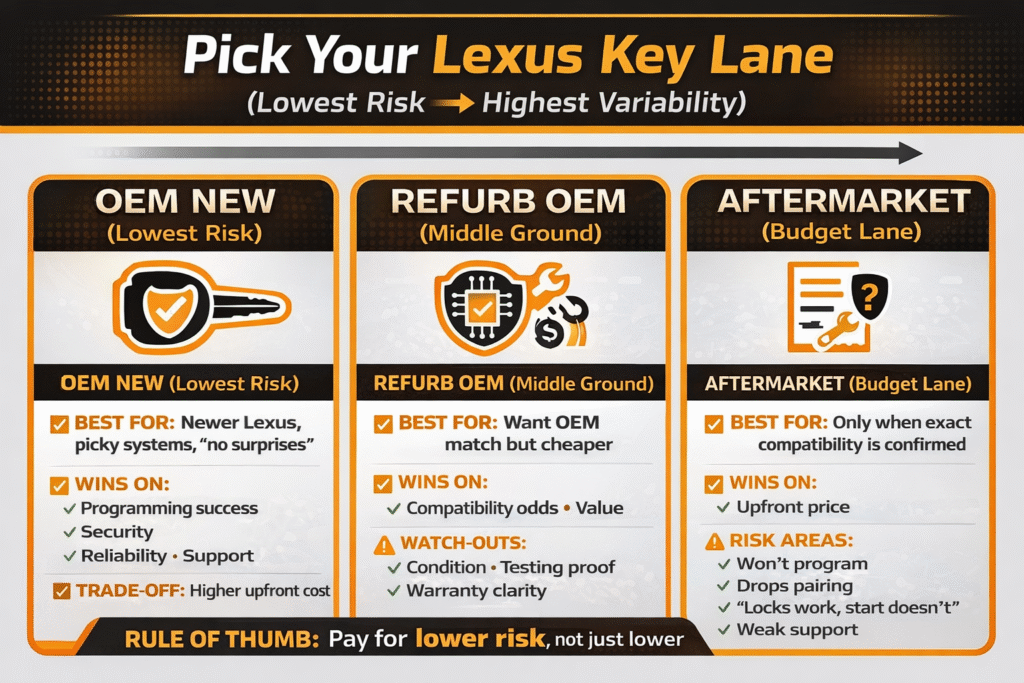
If you want the safest bet, OEM Lexus keys usually deliver the highest programming success rate and the strongest security and anti-theft protection. That’s why, for most owners, OEM is the best Lexus key option—especially on newer models where the car is picky about what it will accept.
Aftermarket can work, but only when it’s verified for your exact Lexus smart key replacement options and programmed by someone who knows the platform. Refurbished OEM often sits in the middle: better match than many aftermarket fobs, but condition and support vary. So when people ask which Lexus key is better, OEM or aftermarket, the honest answer is “OEM for lowest risk, aftermarket only with checks.”
- Choose OEM: Best for success rate and long-term confidence.
- Choose Aftermarket (Carefully): Only if compatibility is confirmed for your exact Lexus.
- Consider Refurb OEM: Good middle option if it’s tested and backed by support.
- Spare Key Plan: OEM is usually the smoothest path for adding a spare.
- Lost All Keys: Lean OEM or dealer-supported options to reduce setbacks.
- Decision Factors: Match your budget to risk, not just price.
OEM, Aftermarket, And Refurbished OEM: What Each One Means
When people compare Lexus smart key replacement options, they often mix three different things into one bucket. The difference between OEM and aftermarket Lexus keys isn’t only price—it’s how closely the fob matches vehicle-specific key requirements, how predictable programming will be, and what kind of support you have if something fails later.
Here’s the clean breakdown so “OEM key fob vs aftermarket” doesn’t feel confusing. Think of these as three separate lanes: OEM new (lowest risk), refurbished OEM (middle ground), and aftermarket (budget lane with higher variability).
OEM New (Factory-Spec Key/Fob)
OEM Lexus keys are factory-spec parts made to match the car’s system as closely as possible. That’s why OEM tends to have the most consistent results—both in programming and day-to-day use. If your goal is fewer surprises, this is usually the safest option because it’s built around the vehicle’s exact requirements, not a “close enough” guess.
- What It Is: Brand-new, factory-spec Lexus key/fob.
- What To Expect: Best match, smoothest programming, more consistent performance.
Refurbished / Used OEM (Genuine Part, Not Always a Clean Slate)
A refurbished OEM Lexus key is still a genuine fob, but it’s not brand new. Sometimes it’s a great middle option because the core hardware is OEM. The trade-off is condition and history—buttons, casing, internal wear, and who is backing it if there’s a problem. Treat it like buying a used part: it can be solid, but you need clarity on testing and support.
- What It Is: Genuine OEM fob that’s been used and resold/refreshed.
- What To Expect: Better odds than many aftermarket fobs, but quality can vary by condition.
Aftermarket (Third-Party Build With Mixed Consistency)
Aftermarket Lexus keys are third-party fobs made to imitate OEM. Some work fine, but the biggest issue is consistency. Two fobs can look identical and still behave differently once you try to program them, especially on newer Lexus models that are strict about specs. This is where most “it won’t program” headaches come from—because the fob doesn’t meet the vehicle-specific key requirements closely enough.
- What It Is: Third-party replacement fob (not factory).
- What To Expect: Lower upfront cost, higher chance of compatibility and reliability issues unless verified.
The Real Differences That Matter
A clean OEM vs aftermarket Lexus keys comparison comes down to what actually affects results, not what the listing claims. Lexus keys aren’t just buttons—they’re security credentials. So the “best” key is the one that programs cleanly, passes security checks, starts reliably, and comes with support if something goes wrong. That’s what a proper Lexus key fob quality comparison is really measuring.
These five factors don’t overlap, and each one can be a dealbreaker by itself. If any single gate fails, you’ll feel it fast—either the fob won’t program, it won’t start, it behaves inconsistently, or you’re stuck with no help after the job.
Will It Program Properly On Your Lexus?
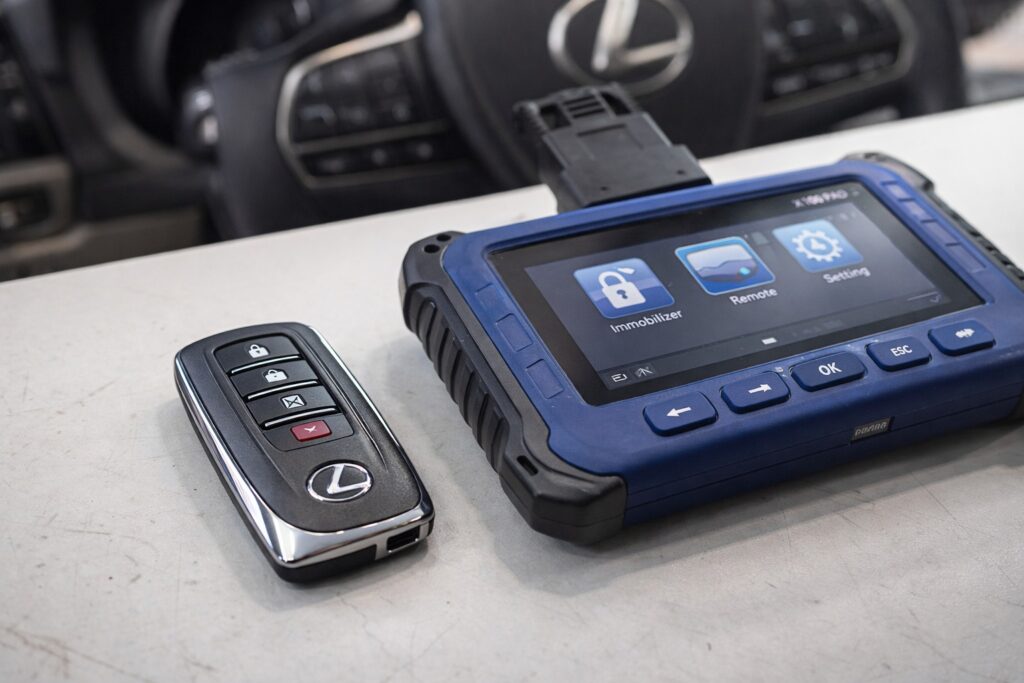
Programming compatibility is the first gate. A fob can look identical and still be the wrong match for your Lexus because smart key compatibility depends on vehicle-specific key requirements. That includes the internal electronics and the way the fob communicates with the car. OEM parts usually match more predictably, while aftermarket consistency varies. In real life, failures show up as “won’t register,” “programs but drops out,” or “works for locks but not for other functions.” The safest approach is to treat Lexus key programming compatibility like a yes/no test: either it’s a compatible key fob for your exact model, or it’s not—no amount of re-trying fixes a mismatch.
Security And Authentication: What The Car Accepts
Lexus treats keys like credentials, not accessories. That means the car checks identity before it grants access, and encrypted authentication is part of that trust. OEM Lexus key security features are designed to align with the Lexus key authentication process, so the car is more likely to recognize it as a proper credential. Aftermarket keys can still work, but the risk is that the fob doesn’t behave exactly the way the system expects. In real life, this shows up as intermittent “key not detected,” odd proximity behavior, or a fob that programs but doesn’t stay consistent over time. Smart key security is about stability, not just “it worked once.”
Immobilizer Pairing And Start Permission
This is the final gate that blocks a lot of problem keys. A key can unlock doors and still fail to start the car because the immobilizer and ECU pairing controls start authorization. In plain language: the car has to “accept” the key for starting, not just for unlocking. Lexus immobilizer compatibility matters because the immobilizer system is built to stop unauthorized keys from being added easily. Aftermarket Lexus key programming risks often show up here—especially when owners go through multiple fobs trying to find one that will fully pair. The real-world symptom is simple: locks work, but the engine won’t start, or the push-start won’t start.
Reliability: Range, Buttons, And Lifespan
Even if a key program runs perfectly, it still has to live a hard daily life—drops, pocket pressure, heat, moisture, and thousands of button presses. Reliability and lifespan are where many aftermarket fob problems show up. A Lexus key fob quality comparison isn’t only about the outside casing; it’s signal stability, battery contact quality, button feel, and internal board durability. In real life, weak hardware looks like short-range, double-click issues, stuck buttons, or a fob that drains batteries too fast. OEM tends to be more consistent. Aftermarket can be fine, but quality varies, so long-term durability is the real test.
Warranty And Support If It Fails
Support is what separates a frustrating key purchase from a manageable one. Warranty and support matters because key work isn’t always “one and done.” If a fob fails after programming, you need accountability—proof of what was supplied and what was done. OEM Lexus key benefits usually include clearer warranty pathways and better traceability, while aftermarket support varies heavily by seller. In real life, this is where people get stuck: no invoice, no return policy, and no help when the fob starts acting up a week later. Dealer-level diagnostics can help in some cases, but the smartest move is getting proper paperwork up front so you’re not left alone if something goes wrong.
Cost vs Value Table (OEM vs Aftermarket Lexus Keys)
| Factor (What Drives Value) | OEM Lexus Key (Typical Outcome) | Aftermarket Lexus Key (Typical Outcome) | What It Means For You |
| Parts Sourcing | More consistent match to vehicle | Quality/spec can vary by seller | Wrong spec = wasted time |
| Programming Success Rate | Usually higher | Can be hit-or-miss | More retries = more cost |
| Rework Risk | Lower chance of repeat issues | More consistent match to the vehicle | Repeat visits add up |
| Support / Warranty | Clearer support path | Support varies widely | No support = you’re stuck |
| Time To Finish The Job | Often smoother workflow | May need extra testing or swaps | More time = more labour |
| Total Value vs Price | Higher value, higher upfront cost | Lower upfront cost, higher risk | Cheap can become expensive |
Dealer vs Locksmith: Who Should Handle Your Key?
When deciding between a dealer and a locksmith for your Lexus key, the best choice depends on your situation. Dealers are best for OEM sourcing and situations needing dealer-level diagnostics, like security gateway issues or when parts are OEM-only. On the other hand, specialist locksmiths excel at practical workflows, like spare key creation or simple replacements, where fewer system restrictions apply.
A clear capability-by-scenario split ensures you don’t waste time or money. Locksmiths handle routine programming efficiently, but if it’s a complex issue (like module faults), the dealership might be the better option.
- Dealers are best for: OEM key sourcing, security gateway access, and complex diagnostics.
- Locksmiths excel at: Spare key programming, quick replacements, and on-site service.
- Dealer programming: Ideal for new or uncommon key systems, dealer-level access needed.
- Locksmith programming: Great for high-volume, routine key programming.
- For all keys lost, a dealer may be necessary for more security checks and diagnostics.
- For cost-efficiency, Locksmiths generally provide more affordable options for simple tasks.
Best Choice By Situation (Spare Key vs Lost All Keys)
When it comes to choosing between OEM vs aftermarket Lexus keys, the right option depends on the situation. Whether you’re making a spare, dealing with a damaged fob, or replacing all keys, each scenario has its own best choice. Knowing what to expect will save you time, money, and frustration.
If You’re Making A Spare (Lowest Risk)
For spare keys, OEM is usually the safest choice. OEM parts are designed to match your vehicle’s exact specifications, ensuring smooth programming and fewer issues down the road. Aftermarket keys can work, but only if verified for your specific Lexus model and programmed by a professional car locksmith.
- Best choice: OEM Lexus key
- Why: Best programming success rate, reliable fit
- Aftermarket only if: Verified compatibility for your specific Lexus model
If Your Fob Is Damaged Or Unreliable
If your key fob is damaged or unreliable, go for the option that guarantees long-term reliability. OEM is usually the better option here due to its durability and consistency. Aftermarket fobs are cheaper, but their reliability often falls short. Look for a high-quality car key replacement to avoid further problems.
- Best choice: OEM Lexus key fob
- Why: Long-term reliability, consistent range
- Aftermarket risk: Potential short lifespan, unreliable range
If You Lost All Keys (Highest Risk)
Losing all keys is the highest complexity scenario and requires higher security steps. In this case, OEM keys are recommended as they align with the car’s security protocols, ensuring proper pairing with the immobilizer and ECU. Aftermarket keys can work, but they carry more risks and often fail to meet security standards.
- Best choice: OEM Lexus key
- Why: Higher security alignment, no reprogramming issues
- Aftermarket risk: Failure to pair with immobilizer, security risks
- Dealer may be necessary for complex security systems and diagnostics
How To Reduce Risk If You Choose Aftermarket
Choosing aftermarket Lexus keys can be cost-effective, but it comes with risks. To avoid wasted money and potential headaches, follow a few simple safeguards before you buy. Verifying compatibility, checking return policies, and ensuring proper programming support can make the difference between success and failure.
Taking the right steps up front can help you avoid the most common aftermarket Lexus key programming risks. Always ask about vehicle-specific key requirements, and confirm the fob matches your car’s system. A little upfront research can save you from expensive rework.
- Verify Compatibility: Make sure the fob matches your Lexus model and year.
- Ask For A Return Policy: Get clear on returns in case of issues.
- Request Proof/Invoice: Ensure proper documentation for warranty and support.
- Check Programming Support: Ask if they can program it to your Lexus.
- Avoid Low-Quality Sellers: Stick to trusted vendors with good reviews.
- Test Before Full Payment: Confirm the fob works as expected before completing the purchase.
FAQs
Not all locksmiths can program keys for newer Lexus models. Due to advanced immobilizer and ECU pairing systems, specialized tools and access are required. While some locksmiths can handle the job, it’s best to check if they can support your Lexus key programming compatibility.
In most cases, OEM Lexus keys offer higher security and reliability, aligning perfectly with your car’s systems. Aftermarket keys can work, but they often carry higher risks, such as programming failure or immobilizer issues. OEM is usually the safer, more reliable option.
Some locksmiths lack access to the specialized software and tools required for Lexus key programming, especially for 2020–2025 models. Without the right equipment, they cannot bypass security protocols or connect to dealer-level diagnostics to program newer smart keys or transponder keys properly.
Not necessarily. While dealers are ideal for complex situations requiring dealer-level diagnostics, many specialist locksmiths can handle programming for spare keys or simple replacements. It depends on your car’s specific needs—like whether it requires OEM parts or if you’re dealing with an all-keys-lost scenario.
Aftermarket keys can be a budget-friendly option, but they often come with programming risks. They may not be fully compatible with your vehicle’s Lexus key authentication process, leading to inconsistent performance or even failure to start the car. Always verify compatibility before choosing an aftermarket key.
Conclusion
In conclusion, whether you choose an OEM or aftermarket Lexus key, it’s essential to understand the differences and the risks involved. OEM keys offer higher reliability and compatibility, making them the safest choice for most owners. However, aftermarket keys can be a cost-effective alternative if verified and programmed correctly. Regardless of your choice, always ensure you’re working with a trusted locksmith or dealer who understands your vehicle’s security system. This way, you can avoid unnecessary costs and headaches while ensuring your car remains secure.